Just spent a merry two hours cleaning the various aviaries with a pressure washer. How I managed before getting one, God knows. Getting an aviary clean and keeping it so are the most tedious chores in falconry, but essential.
Most of the diseases that affect hawks in captivity can be avoided by always ensuring the aviary is clean of old food and droppings, which harbour the germs that can infect the birds. A floor of small gravel stones about three inches deep is very good, provided it is raked regularly and the bones, castings etc picked out. It can then be sprayed with a viricidal disinfectant. Perches and ledges also need to be sprayed.
Birds being birds, their droppings, or " mutes " in falconry-speak, can be all over the place, although obviously concentrated near the perches. That's where the power washer comes in handy.
Cassius, Lady Macbeth and Orlando, the Harris Hawks have just begun their annual moult. Artemis the sparrowhawk has not yet started. For the first three, the moult will be a long-drawn out affair. They have to fly throughout the summer, which of course is the most popular time for customers at North Devon Hawk Walks. This mean their diet has to be controlled to keep them at flying weight. This slows down the moulting process. Falconers who don't fly during the summer just put the birds away and keep them fat so as to get the process over as soon as possible. Some feed supplements so as to speed it up.
Artemis won't be flying in the summer. Her forte is scaring away starlings in the winter. So she's getting lots of food. In order to keep her tame, I'm making time to feed her on the fist and keep her aware of who I am.
The whole avian gang will be with me at the North Devon Show, the mid-Devon Show and the Filleigh Show this year. Come along and meet them !
Showing posts with label falconry. Show all posts
Showing posts with label falconry. Show all posts
Sunday, 5 May 2013

Tuesday, 22 May 2012
Haggard hawk
Life continues, here at North Devon Hawk Walks.
I'm looking after a young male Harris Hawk for a guy who has not been able to devote as much time to falconry as he would like. I agreed to take on Hero for a month, to do a bit of remedial training and manning. He's been trained and hunted, a bit, but because he's had not much done with him, he's in danger of turning haggard.
Haggard means, basically, going back to the wild. So with Hero it's been a case of back to basics. Started off with sitting with him in the aviary, with him tethered. Then feeding him on the fist, then walking around with him, then creance flying, then flying free. Sounds easy!
Actually, it wasn't too bad at all. Because of course, he was just being reminded of everything, not like Orlando ( see previous posts) who is learning it all from scratch.
Anyway, Hero is now flying free ( at about 1lb 5ounces), and following on nicely through the trees.
The only slight problem is that although he will follow nicely, he won't go far enough ahead. He needs to learn to do this if he is to be any good at hunting. But I've still got a few weeks left to achieve that.
Orlando continues to frustrate and intimidate in almost equal measures. She's got a tremendous bellow of rage that she uses whenever I have the temerity to try and pick her up from a perch. But for several weeks now she's been free-lofted ( ie flying free in her aviary), as well as learning to follow on. She just needs lots and lots of manning. I probably need to get her hunting ASAP as that will help her psychologically. Not enough hours in the day.! ( Or rabbits in North Devon).
My wife Jane is off to learn about using Facebook for business today. So hopefully I can pick her brains and the next stage for North Devon Hawk Walks will be to join the Facebook empire.
Look at the website www.NorthDevonHawkWalks.co.uk for forthcoming events ( Fairs and shows etc). Recently we were at the Devon Wildlife Trust event in Exeter, which is where the picture below was taken. Most kids are fascinated by hawks, and Artemis the sparrowhawk is quite happy to be stroked.

 We shall be at the South Molton Seven Saturdays in Summer event, every Saturday morning, starting 14th July. Come along and meet the hawks.
I'm looking after a young male Harris Hawk for a guy who has not been able to devote as much time to falconry as he would like. I agreed to take on Hero for a month, to do a bit of remedial training and manning. He's been trained and hunted, a bit, but because he's had not much done with him, he's in danger of turning haggard.
Haggard means, basically, going back to the wild. So with Hero it's been a case of back to basics. Started off with sitting with him in the aviary, with him tethered. Then feeding him on the fist, then walking around with him, then creance flying, then flying free. Sounds easy!
Actually, it wasn't too bad at all. Because of course, he was just being reminded of everything, not like Orlando ( see previous posts) who is learning it all from scratch.
Anyway, Hero is now flying free ( at about 1lb 5ounces), and following on nicely through the trees.
The only slight problem is that although he will follow nicely, he won't go far enough ahead. He needs to learn to do this if he is to be any good at hunting. But I've still got a few weeks left to achieve that.
Orlando continues to frustrate and intimidate in almost equal measures. She's got a tremendous bellow of rage that she uses whenever I have the temerity to try and pick her up from a perch. But for several weeks now she's been free-lofted ( ie flying free in her aviary), as well as learning to follow on. She just needs lots and lots of manning. I probably need to get her hunting ASAP as that will help her psychologically. Not enough hours in the day.! ( Or rabbits in North Devon).
My wife Jane is off to learn about using Facebook for business today. So hopefully I can pick her brains and the next stage for North Devon Hawk Walks will be to join the Facebook empire.
Look at the website www.NorthDevonHawkWalks.co.uk for forthcoming events ( Fairs and shows etc). Recently we were at the Devon Wildlife Trust event in Exeter, which is where the picture below was taken. Most kids are fascinated by hawks, and Artemis the sparrowhawk is quite happy to be stroked.


Wednesday, 22 February 2012
Patience is a virtue
Definitely time that I posted something!
Orlando, the female Harris Hawk that I wrote about in the last post, continues to occupy a lot of my time. Because she wasn't touched at all for the the first 18 months of her life, she is a lot more difficult to train than birds that are bought at three months of age and then trained, which is the norm.
We've progressed to the stage where I can touch, stroke and generally fiddle about with her without losing a finger. This is important, because anyone who owns a bird of prey that is to be used in falconry needs to be able to check the bird for injuries, fit equipment etc.
It's always possible to "cast" a bird, that is getting someone to cover the bird with a towel while she is on your fist and thus immobilise her, but as you can imagine, the birds don't like this very much at all. Because the Harris Hawk is quite intelligent, for a bird of prey, they soon learn to be way of anyone sneaking up on them with a towel. If the casting always takes place in the same room, they can become unwilling to enter that room.
But as I say, I am now trusted enough to be able to handle her most of the time. Except for her feet. Her tolerance of being touched does not yet extend to her feet. She will allow me touch them a couple of times every two or three minutes, but no more than that. I've learned to watch for the tell-tale shift of balance as she takes the weight off one foot preparatory to striking me with it. But as with most things connected with falconry, time and patience will carry me through.
The sparrowhawk, Artemis, is taking a break now after a mid winter career of starling scaring. The winter has been generally mild down here in Devon so there are less starlings around. She did a good job of scaring them away from the farms where we were employed. When we were outside, I would point her at a tree full of starlings and she'd head straight for it at speed. She'd fly quite low and then pull up at the last moment into a steep climb which carried her up into the branches. Inside the cattle sheds, she flew low and fast, chasing the starlings around, through, over and under the various obstacles until either she needed a rest, or she caught one.
The tail feathers of a sparrowhawk are very brittle. They don't bend anything like as much as those of the Harris and are very prone to breaking. Artemis now has only a stump of a tail, a shadow of its former glory. It doesn't reduce her speed but it does make her less manouverable. The tail feathers will be renewed, along with all her other feathers, during the coming summer in the annual moult.
During the moult, the feathers drop out, in a regular pattern, over a period of months and new ones grow out to replace them. Because the feathers come out in a regular pattern, the bird is never "lop-sided" by having say two wing feathers missing on one side and none on the other. Over the years, I've noticed, that the Harris feathers drop out at two day intervals. So if there is a wing feather on the floor of the aviary this morning, then the corresponding feather from the other wing, will be on the floor in two days time.
Falconers tend to keep their birds moulted out feathers ( the big ones, that is), so that they can be used to repair any damaged or broken feathers on the bird. This is called "imping" and basically involves fitting an internal splint or brace made from bamboo or plastic within the hollow spine of the feather that is on the bird and gluing a section from a moulted feather onto the splint. If it's done well, you can't see the join ( as Eric Morecombe would say).

 Anyone interested in flying hawks is welcome to get in touch with wwwNorthDevonHawkWalks.co.uk We fly around the North Molton/ Withypool area of Exmoor in Devon, all year round, any day of the week. I enclose a couple of photos, both taken by customers recently.
Orlando, the female Harris Hawk that I wrote about in the last post, continues to occupy a lot of my time. Because she wasn't touched at all for the the first 18 months of her life, she is a lot more difficult to train than birds that are bought at three months of age and then trained, which is the norm.
We've progressed to the stage where I can touch, stroke and generally fiddle about with her without losing a finger. This is important, because anyone who owns a bird of prey that is to be used in falconry needs to be able to check the bird for injuries, fit equipment etc.
It's always possible to "cast" a bird, that is getting someone to cover the bird with a towel while she is on your fist and thus immobilise her, but as you can imagine, the birds don't like this very much at all. Because the Harris Hawk is quite intelligent, for a bird of prey, they soon learn to be way of anyone sneaking up on them with a towel. If the casting always takes place in the same room, they can become unwilling to enter that room.
But as I say, I am now trusted enough to be able to handle her most of the time. Except for her feet. Her tolerance of being touched does not yet extend to her feet. She will allow me touch them a couple of times every two or three minutes, but no more than that. I've learned to watch for the tell-tale shift of balance as she takes the weight off one foot preparatory to striking me with it. But as with most things connected with falconry, time and patience will carry me through.
The sparrowhawk, Artemis, is taking a break now after a mid winter career of starling scaring. The winter has been generally mild down here in Devon so there are less starlings around. She did a good job of scaring them away from the farms where we were employed. When we were outside, I would point her at a tree full of starlings and she'd head straight for it at speed. She'd fly quite low and then pull up at the last moment into a steep climb which carried her up into the branches. Inside the cattle sheds, she flew low and fast, chasing the starlings around, through, over and under the various obstacles until either she needed a rest, or she caught one.
The tail feathers of a sparrowhawk are very brittle. They don't bend anything like as much as those of the Harris and are very prone to breaking. Artemis now has only a stump of a tail, a shadow of its former glory. It doesn't reduce her speed but it does make her less manouverable. The tail feathers will be renewed, along with all her other feathers, during the coming summer in the annual moult.
During the moult, the feathers drop out, in a regular pattern, over a period of months and new ones grow out to replace them. Because the feathers come out in a regular pattern, the bird is never "lop-sided" by having say two wing feathers missing on one side and none on the other. Over the years, I've noticed, that the Harris feathers drop out at two day intervals. So if there is a wing feather on the floor of the aviary this morning, then the corresponding feather from the other wing, will be on the floor in two days time.
Falconers tend to keep their birds moulted out feathers ( the big ones, that is), so that they can be used to repair any damaged or broken feathers on the bird. This is called "imping" and basically involves fitting an internal splint or brace made from bamboo or plastic within the hollow spine of the feather that is on the bird and gluing a section from a moulted feather onto the splint. If it's done well, you can't see the join ( as Eric Morecombe would say).


Tuesday, 11 October 2011
Hunting with hawks


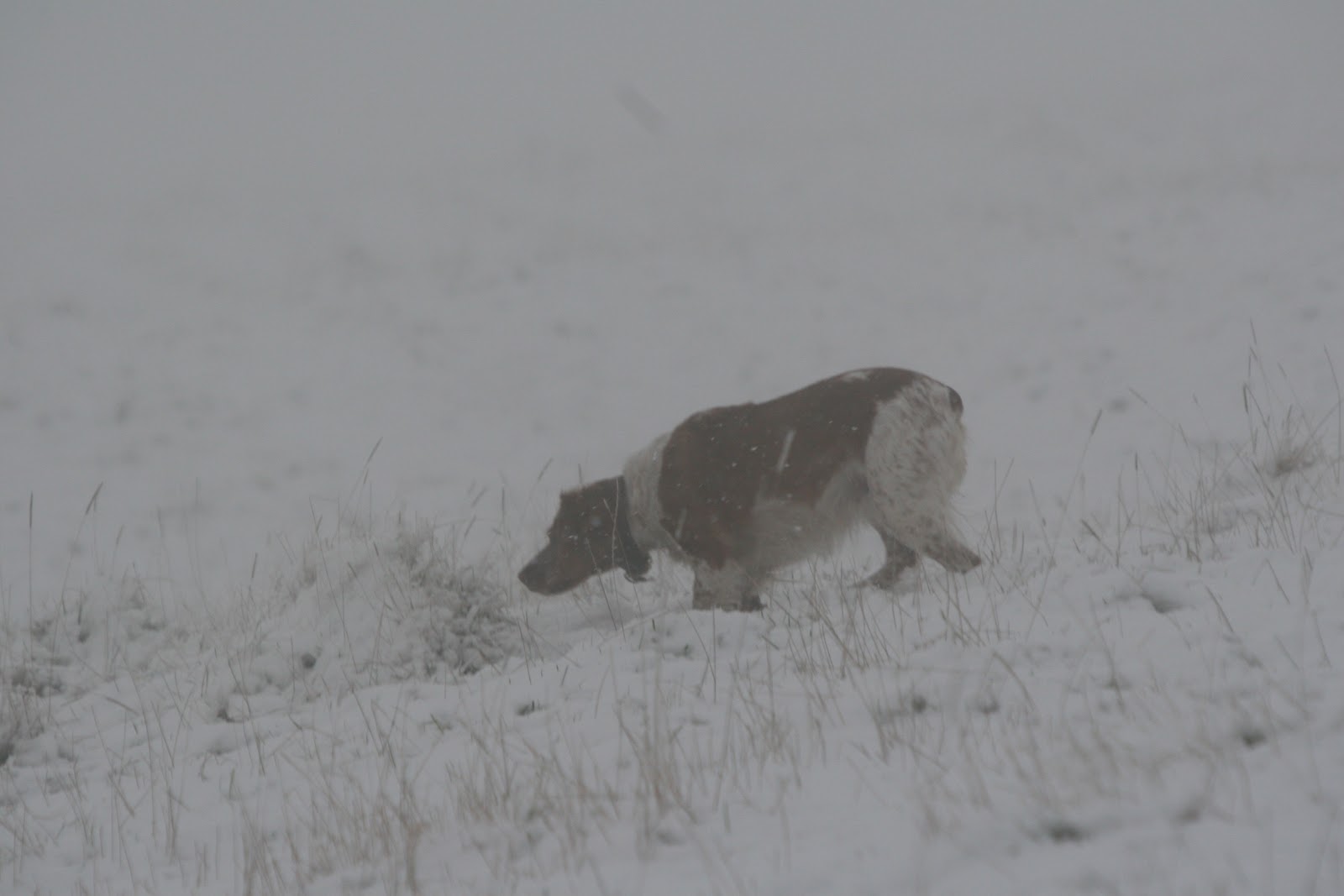
Well,here at North Devon Hawk Walks, the hunting season is with us and Lady Macbeth has already accounted for two pheasants. Not particularly spectacular flights, both ended up in deep undergrowth and were a result of her stalking the pheasants while they were on the ground and she was circling overhead. She's had seven years practice and is quite good at it. She gets a reward of fresh meat while she is sitting on her kill, then I ( diplomatically and carefully) trade the dead pheasant for a lump of meat, without feathers, that she can eat immediately. As soon as she's given me the pheasant, she loses interest in it. Yet two minutes later, we're off hunting again and she's as keen as ever.
Above are some photos of Puzzle, my Brittany. She is a hunter, pointer,retriever, but I use her only for pointing. Macbeth has learned to pay attention to what the dog is doing and if the hawk goes off after something the dog will dash to keep up with her. They're a very good partnership, but it's taken seven years to get to this happy state of affairs. Cassius, my one year old male hawk is still a bit wary of the dog and she tends to put him off hunting. The top and bottom photos above show Puzzle pointing. It's a very distinctive bit of body language. It's as though the dog has hit an invisible wall and frozen solid. The smell of the pheasant, or rabbit, stops her dead in her tracks. It's got so that now I can tell how far ahead of her the pheasant/rabbit is, by noting how low to the ground her head is. The lower her head, the closer it is. The middle photo, I've included purely because it reminds me that dogs are descended from wolves.
At North Devon Hawk Walks, I'm lucky to have access to great hunting grounds, for pheasants, and so far this season I've taken out two customers, who both had a great time. Several more customers are booked in for our three hour hunts and I hope to get some photos of birds and dogs in action.
Take a look at www.NorthDevonHawkWalks.co.uk to get an idea of what we do.
Friday, 5 August 2011
Out and about with the hawks.
This is a busy time of year at North Devon Hawk Walks. Since I last posted, we've been to the North Devon show as well as the Mid Devon show. My friend Tom, his wife Sam and baby Daniel ( also known as The Youngest Falconer in Britain) helped me run the stall and display the birds.
This year, as well as having Lady Macbeth and Cassius the Harris Hawks on hand, we also had the Sparrowhawk and Tom's latest addition, an African Eagle Owl. ( Pictures to follow). The birds were, as always, extremely popular and we spent the entire day on our feet showing them to the crowd around the stall, answering questions and posing them for photographs. There is something about being close to a bird of prey that appeals to an awful lot of people!
The Sparrowhawk is growing at an alarming rate and has gone from being a ball of fluff to a proper bird in about three weeks. People at the show were amazed that the cute lump of fluff in the photo was the same as the bird standing on my fist. She doesn't have a name yet, so we invited people to think of a name for her, with a prize of a free hawk walk voucher to the best name. I haven't yet had time to look through the seven pages of suggestions.
The Harris Hawks have been busy over the past weeks introducing people to falconry on Exmoor. It's school holiday time now so lots of children have been getting up close to Cassius, who most agree is a friendly little fellow, and Lady Macbeth who most agree is a lot more aloof, and aware of her own power and dignity. That's the trouble with giving animals historic or literary names, they tend to live up to them.


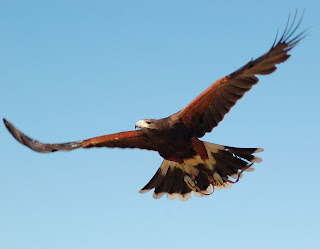


 The whole gang can be seen at the tearooms in Withypool on Exmoor, most weekend mornings or lunch times as we wait there to meet customers. I have the Sparrowhawk in her portable nest sitting on one of the outside tables, where she spends her time absorbing new sights and sounds, and giving the local blackbirds and sparrows the evil eye. It's important for a young falconry bird to be exposed to as much as possible, in a controlled and safe way, as soon as possible. That's so that in a couple of months time when we're out hunting she's not going to be scared witless just because she sees a man on a horse, or someone wearing sunglasses or whatever. It's part of the manning process, and as I said in one of the earlier posts, it never stops.
This year, as well as having Lady Macbeth and Cassius the Harris Hawks on hand, we also had the Sparrowhawk and Tom's latest addition, an African Eagle Owl. ( Pictures to follow). The birds were, as always, extremely popular and we spent the entire day on our feet showing them to the crowd around the stall, answering questions and posing them for photographs. There is something about being close to a bird of prey that appeals to an awful lot of people!
The Sparrowhawk is growing at an alarming rate and has gone from being a ball of fluff to a proper bird in about three weeks. People at the show were amazed that the cute lump of fluff in the photo was the same as the bird standing on my fist. She doesn't have a name yet, so we invited people to think of a name for her, with a prize of a free hawk walk voucher to the best name. I haven't yet had time to look through the seven pages of suggestions.
The Harris Hawks have been busy over the past weeks introducing people to falconry on Exmoor. It's school holiday time now so lots of children have been getting up close to Cassius, who most agree is a friendly little fellow, and Lady Macbeth who most agree is a lot more aloof, and aware of her own power and dignity. That's the trouble with giving animals historic or literary names, they tend to live up to them.


Saturday, 25 June 2011
Mantling.
I thought I'd describe a little of my experience of how the two hawks differ in this regard. Mantling is when the hawk hides the food or prey by spreading her wings and tail over it. The idea, of course, is to hide it from other predators.
When I take people out on Exmoor with North Devon Hawk Walks, I usually end the walk by firing a few heads of quail up into the air for Macbeth to chase, and, usually, catch. It's quite spectacular and always gets a cheer from the customers when she catches it in mid-air. There's a lot going on when she chases it. She has to work out when it is going to stop going up and start coming down, she has to allow for the wind strength and direction blowing it, and her, around. She flies upwards, with her head well back, looking upwards. When she has got close enough to it, she flips up and back, so that she is almost standing on her tail in the air, and grabs at it with her claw. If she misses it, she turns into a corkscrew dive to try and catch it up. Quite spectacular as I say.
Anyway, once she's eaten the head ( which is about the size of the top joint of my thumb), her behaviour changes remarkably. Up until that point she has been coming to the customer's fist for a small piece of meat ( rabbit or quail), eating it on the fist and then usually hopping or flying off. While crunching up a quail head, she will mantle as though her life depended upon it. When she's finished eating it, she is quite aggressive to any move being made towards her upon the glove, but only for about thirty seconds. After that she calms down and she's back to her normal self.
I think the blood, brains and bone in the quail head cause adrenaline to be released in Macbeth's blood stream and this triggers the mantling and possessiveness. ( Sorry to be so gory).
Just lately she has not been catching the heads and seems to be not quite so hell-for-leather chasing them. I think she's worked out that what goes up, must come down, and all she has to do is mark where it lands. The mantling and possessiveness is still there, but the flight is not nearly so exciting. I think I'll have to find a way of making it impossible for her to get the head without catching it in mid-air. Not sure how. In fact, I've no idea how !
Cassius, being a lot younger, is not nearly so successful at catching the heads but he is still very excited about the whole game and gives it his best shot. But, no mantling. He's just his normal, placid self. People are sometimes surprised by how different the personalities of the two hawks are, they expect one bird to be pretty much the same as the other, as I've described, they're not !
When I take people out on Exmoor with North Devon Hawk Walks, I usually end the walk by firing a few heads of quail up into the air for Macbeth to chase, and, usually, catch. It's quite spectacular and always gets a cheer from the customers when she catches it in mid-air. There's a lot going on when she chases it. She has to work out when it is going to stop going up and start coming down, she has to allow for the wind strength and direction blowing it, and her, around. She flies upwards, with her head well back, looking upwards. When she has got close enough to it, she flips up and back, so that she is almost standing on her tail in the air, and grabs at it with her claw. If she misses it, she turns into a corkscrew dive to try and catch it up. Quite spectacular as I say.
Anyway, once she's eaten the head ( which is about the size of the top joint of my thumb), her behaviour changes remarkably. Up until that point she has been coming to the customer's fist for a small piece of meat ( rabbit or quail), eating it on the fist and then usually hopping or flying off. While crunching up a quail head, she will mantle as though her life depended upon it. When she's finished eating it, she is quite aggressive to any move being made towards her upon the glove, but only for about thirty seconds. After that she calms down and she's back to her normal self.
I think the blood, brains and bone in the quail head cause adrenaline to be released in Macbeth's blood stream and this triggers the mantling and possessiveness. ( Sorry to be so gory).
Just lately she has not been catching the heads and seems to be not quite so hell-for-leather chasing them. I think she's worked out that what goes up, must come down, and all she has to do is mark where it lands. The mantling and possessiveness is still there, but the flight is not nearly so exciting. I think I'll have to find a way of making it impossible for her to get the head without catching it in mid-air. Not sure how. In fact, I've no idea how !
Cassius, being a lot younger, is not nearly so successful at catching the heads but he is still very excited about the whole game and gives it his best shot. But, no mantling. He's just his normal, placid self. People are sometimes surprised by how different the personalities of the two hawks are, they expect one bird to be pretty much the same as the other, as I've described, they're not !
Tuesday, 14 June 2011


Falconry history.
Just got back from giving a talk to one of our local chapters of the University of the 3rd Age, in Filleigh. People often want to learn something about the birds and the history of falconry, and I'm always happy to oblige. I enjoy the research, and it seems to be an almost inexhaustable subject. Usually, someone has been out for a hawk walk with us at North Devon Hawk Walks, (www.NorthDevonHawkWalks.co.uk for details), found it interesting and arranged for me to visit their group.
Falconry itself is probably about three thousand years old. One of, if not the, oldest depiction of someone hawking is an Etruscan mosaic. The Roman weren't interested in it but most of the nations they ruled were, and there are Celtic sculptures and brooches depicting it. It probably began in the middle East and really reached its highest point in Europe during the Middle Ages. Following the Crusades a lot of Middle-Eastern influences were imported to Europe ( spices, building techniques, and ancient knowledge etc), falconry received a boost from this and from the interest of the Holy Roman Emperor, Frederick the second, who wrote a book about it in the 13th century.
Although it began as a way of getting meat on the table, falconry later developed into almost a craze among the nobility and rising middle classes in Europe. It became a way of showing conspicuous consumption ( you needed a lot staff, land, money and time to practice it), and competitiveness ( my falcon is bigger, braver, flies higher than yours). Along with other forms of hunting it became one of the necessary accomplishments of any gentleman. A falcon that flew high, attacked birds bigger and more dangerous than itself and was victorious, was believed to display all the attributes a brave young man should aspire to. It is no accident that many shields and coats of arms were decorated with eagles, hawks and falcons. Princes and aristocrats in medieval and Renaissance Europe were fanatical about it. For many it took up nearly all their time and most of their energy,. There were few who did not regard it as their privilege and duty and as a very serious occupation.
Laws relating to falconry give an indication of how it was viewed.
In 1320 the Grand Prince of Moscow made falconers above the law. ( That would be nice !)
Under King Henry 8th of England, it was illegal, without the express authority of the king, to fly a bird bred in England. Falconers had to import their birds from elsewhere. This law aimed to ensure a regular supply of hunting birds in the mews of the king and aristocracy.
Charles 6th of France restricted falconry to nobles.
A good falcon was not only a great favourite who went everywhere with her master ( King Harold of England had his with him when he was held captive in Normandy prior to the Battle of Hastings, 1066) but she was also a valuable possession, the result of long training. In England there were strict laws with heavy penalties about returning falcons to their rightful owners. A stray falcon had to be reported to the Sheriff of the county, by law. In the 15th century it was common to see in churches wax effigies of hawks with candles burning nearby and prayers being said for the return of a prized, lost falcon, or for it's recovery from sickness.
The Church authorities passed numerous laws over centuries, in England, aimed at getting the local priests to spend less time hawking and more time on their church duties. The fact that they had to keep on making these laws indicates that they were being ignored.
So, a long history. Falconry nearly died out in the UK in the 1950s, because of persecution by gamekeepers ( protecting pheasants) and the use of pesticides. Only a handful of falconers kept it going. In the 70's, people began importing the Harris Hawk ( Parabuteo Unicinctus) from America. It bred well in captivity and most people who begin hawking nowadays begin with a Harris Hawk.
Anyway, my talk went down well, the birds behaved themselves (you can't house-train a hawk), and everyone enjoyed themselves. I've got another talk tomorrow, in Tiverton. Hopefully I'll be able to use the dreaded PowerPOint to show some pictures so people can see how the different species of birds have different wing/tail shapes and how this affects their hunting techniques.
Falconry itself is probably about three thousand years old. One of, if not the, oldest depiction of someone hawking is an Etruscan mosaic. The Roman weren't interested in it but most of the nations they ruled were, and there are Celtic sculptures and brooches depicting it. It probably began in the middle East and really reached its highest point in Europe during the Middle Ages. Following the Crusades a lot of Middle-Eastern influences were imported to Europe ( spices, building techniques, and ancient knowledge etc), falconry received a boost from this and from the interest of the Holy Roman Emperor, Frederick the second, who wrote a book about it in the 13th century.
Although it began as a way of getting meat on the table, falconry later developed into almost a craze among the nobility and rising middle classes in Europe. It became a way of showing conspicuous consumption ( you needed a lot staff, land, money and time to practice it), and competitiveness ( my falcon is bigger, braver, flies higher than yours). Along with other forms of hunting it became one of the necessary accomplishments of any gentleman. A falcon that flew high, attacked birds bigger and more dangerous than itself and was victorious, was believed to display all the attributes a brave young man should aspire to. It is no accident that many shields and coats of arms were decorated with eagles, hawks and falcons. Princes and aristocrats in medieval and Renaissance Europe were fanatical about it. For many it took up nearly all their time and most of their energy,. There were few who did not regard it as their privilege and duty and as a very serious occupation.
Laws relating to falconry give an indication of how it was viewed.
In 1320 the Grand Prince of Moscow made falconers above the law. ( That would be nice !)
Under King Henry 8th of England, it was illegal, without the express authority of the king, to fly a bird bred in England. Falconers had to import their birds from elsewhere. This law aimed to ensure a regular supply of hunting birds in the mews of the king and aristocracy.
Charles 6th of France restricted falconry to nobles.
A good falcon was not only a great favourite who went everywhere with her master ( King Harold of England had his with him when he was held captive in Normandy prior to the Battle of Hastings, 1066) but she was also a valuable possession, the result of long training. In England there were strict laws with heavy penalties about returning falcons to their rightful owners. A stray falcon had to be reported to the Sheriff of the county, by law. In the 15th century it was common to see in churches wax effigies of hawks with candles burning nearby and prayers being said for the return of a prized, lost falcon, or for it's recovery from sickness.
The Church authorities passed numerous laws over centuries, in England, aimed at getting the local priests to spend less time hawking and more time on their church duties. The fact that they had to keep on making these laws indicates that they were being ignored.
So, a long history. Falconry nearly died out in the UK in the 1950s, because of persecution by gamekeepers ( protecting pheasants) and the use of pesticides. Only a handful of falconers kept it going. In the 70's, people began importing the Harris Hawk ( Parabuteo Unicinctus) from America. It bred well in captivity and most people who begin hawking nowadays begin with a Harris Hawk.
Anyway, my talk went down well, the birds behaved themselves (you can't house-train a hawk), and everyone enjoyed themselves. I've got another talk tomorrow, in Tiverton. Hopefully I'll be able to use the dreaded PowerPOint to show some pictures so people can see how the different species of birds have different wing/tail shapes and how this affects their hunting techniques.
Saturday, 28 May 2011
Shakespeare.
So, a little about the hawks I have.
Lady Macbeth is 8 years old. I purchased her when she was three months old, from Steve Wright, a well-known falconer in the UK. He used to run the Heart of England falconry centre associated with the Mary Arden centre, a Shakespearen themed museum and display centre. There was a tradition that all his hawks got named after Shakespearen characters. We were living in Kelso on the Scottish Borders at that time, so I was looking for a name to describe a blood-thirsty, female, Scottish tyrant. Hence Lady Macbeth. Sometimes she live up to the name a bit too much!
The other hawk is Cassius, 8 months old. Purchased from a breeder in Monmouthshire. He's named after the character in Julius Caesar who is described thus : " Yon Cassius has a lean and hungry look".
Very appropriate for a smaller, slimmer hawk. He flies at 1lb 9 ounces as opposed to Lady M's 2lb 4 ounces.
Yesterday I met Norman Towe, a very experienced falconer. He and his wife come down to stay at the White Horse in Exford every year. He usually brings a couple of owls and hawks and undertakes a few speaking engagements while here. He's a very interesting character, and has had some fascinating jobs . He's a Professor of Mathematics at Oxford among other things. You meet all sorts in falconry.
He mentioned a sobering statistic. He has twenty-four birds, twenty-two of which are rescue cases given by people who took up falconry and then realised they couldn't cope.
The Harris Hawk has made falconry available to thousands who would never have been able to cope with the birds traditionally used. Unfortunately, many of this new generation didn't do enough research or think hard enough about the costs, time and effort involved. When I take people out on hawk-walks ( http://www.northdevonhawkwalks.co.uk/) , they are always surprised to learn that no sort of licence or training is required for anyone who wants to take up falconry.
I'm out with the birds tomorrow at the Sportsman's Inn on Exmoor. They're having a charity day with all sorts of attractions and the birds will be giving a flying display. I hope the weather is better than it is today.
Cassius in particular gets water-logged in damp or rainy conditions. Being young, his feathers don't seem to be as waterproof as Lady M's. They've both begun the annual moult and have lost half a dozen big wing and tail feathers each, with new bright feathers just beginning to peep through.
Enough for today.
Lady Macbeth is 8 years old. I purchased her when she was three months old, from Steve Wright, a well-known falconer in the UK. He used to run the Heart of England falconry centre associated with the Mary Arden centre, a Shakespearen themed museum and display centre. There was a tradition that all his hawks got named after Shakespearen characters. We were living in Kelso on the Scottish Borders at that time, so I was looking for a name to describe a blood-thirsty, female, Scottish tyrant. Hence Lady Macbeth. Sometimes she live up to the name a bit too much!
The other hawk is Cassius, 8 months old. Purchased from a breeder in Monmouthshire. He's named after the character in Julius Caesar who is described thus : " Yon Cassius has a lean and hungry look".
Very appropriate for a smaller, slimmer hawk. He flies at 1lb 9 ounces as opposed to Lady M's 2lb 4 ounces.
Yesterday I met Norman Towe, a very experienced falconer. He and his wife come down to stay at the White Horse in Exford every year. He usually brings a couple of owls and hawks and undertakes a few speaking engagements while here. He's a very interesting character, and has had some fascinating jobs . He's a Professor of Mathematics at Oxford among other things. You meet all sorts in falconry.
He mentioned a sobering statistic. He has twenty-four birds, twenty-two of which are rescue cases given by people who took up falconry and then realised they couldn't cope.
The Harris Hawk has made falconry available to thousands who would never have been able to cope with the birds traditionally used. Unfortunately, many of this new generation didn't do enough research or think hard enough about the costs, time and effort involved. When I take people out on hawk-walks ( http://www.northdevonhawkwalks.co.uk/) , they are always surprised to learn that no sort of licence or training is required for anyone who wants to take up falconry.
I'm out with the birds tomorrow at the Sportsman's Inn on Exmoor. They're having a charity day with all sorts of attractions and the birds will be giving a flying display. I hope the weather is better than it is today.
Cassius in particular gets water-logged in damp or rainy conditions. Being young, his feathers don't seem to be as waterproof as Lady M's. They've both begun the annual moult and have lost half a dozen big wing and tail feathers each, with new bright feathers just beginning to peep through.
Enough for today.
Tuesday, 24 May 2011
Welcome !
Welcome to my blog. I run North Devon Hawk Walks and spend most of my time messing around with hawks on Exmoor, in Devon. I hope to use this blog to help introduce people to falconry and to share my experience of these fascinating creatures.
I've seen blogs described as " vanity web-sites" and I don't intend to let that happen to me! I'll be telling you what the hawks are up to, how they are behaving during our outings, either on hawk-walks or hunting for rabbits and pheasants, and passing on any tips or useful information I pick up that may be of use to other people owning, training or caring for hawks.
I have just two hawks, Lady Macbeth ( an 8 year old female), and Cassius ( a 9 month old male). Both are Harris Hawks. I'll be posting pictures of them in the near future. I hope to buy a female Sparrowhawk later this year. More about that later.
More about myself and the hawks at my website http://www.northdevonhawkwalks.co.uk/
I've seen blogs described as " vanity web-sites" and I don't intend to let that happen to me! I'll be telling you what the hawks are up to, how they are behaving during our outings, either on hawk-walks or hunting for rabbits and pheasants, and passing on any tips or useful information I pick up that may be of use to other people owning, training or caring for hawks.
I have just two hawks, Lady Macbeth ( an 8 year old female), and Cassius ( a 9 month old male). Both are Harris Hawks. I'll be posting pictures of them in the near future. I hope to buy a female Sparrowhawk later this year. More about that later.
More about myself and the hawks at my website http://www.northdevonhawkwalks.co.uk/
Subscribe to:
Posts (Atom)