Definitely time that I posted something!
Orlando, the female Harris Hawk that I wrote about in the last post, continues to occupy a lot of my time. Because she wasn't touched at all for the the first 18 months of her life, she is a lot more difficult to train than birds that are bought at three months of age and then trained, which is the norm.
We've progressed to the stage where I can touch, stroke and generally fiddle about with her without losing a finger. This is important, because anyone who owns a bird of prey that is to be used in falconry needs to be able to check the bird for injuries, fit equipment etc.
It's always possible to "cast" a bird, that is getting someone to cover the bird with a towel while she is on your fist and thus immobilise her, but as you can imagine, the birds don't like this very much at all. Because the Harris Hawk is quite intelligent, for a bird of prey, they soon learn to be way of anyone sneaking up on them with a towel. If the casting always takes place in the same room, they can become unwilling to enter that room.
But as I say, I am now trusted enough to be able to handle her most of the time. Except for her feet. Her tolerance of being touched does not yet extend to her feet. She will allow me touch them a couple of times every two or three minutes, but no more than that. I've learned to watch for the tell-tale shift of balance as she takes the weight off one foot preparatory to striking me with it. But as with most things connected with falconry, time and patience will carry me through.
The sparrowhawk, Artemis, is taking a break now after a mid winter career of starling scaring. The winter has been generally mild down here in Devon so there are less starlings around. She did a good job of scaring them away from the farms where we were employed. When we were outside, I would point her at a tree full of starlings and she'd head straight for it at speed. She'd fly quite low and then pull up at the last moment into a steep climb which carried her up into the branches. Inside the cattle sheds, she flew low and fast, chasing the starlings around, through, over and under the various obstacles until either she needed a rest, or she caught one.
The tail feathers of a sparrowhawk are very brittle. They don't bend anything like as much as those of the Harris and are very prone to breaking. Artemis now has only a stump of a tail, a shadow of its former glory. It doesn't reduce her speed but it does make her less manouverable. The tail feathers will be renewed, along with all her other feathers, during the coming summer in the annual moult.
During the moult, the feathers drop out, in a regular pattern, over a period of months and new ones grow out to replace them. Because the feathers come out in a regular pattern, the bird is never "lop-sided" by having say two wing feathers missing on one side and none on the other. Over the years, I've noticed, that the Harris feathers drop out at two day intervals. So if there is a wing feather on the floor of the aviary this morning, then the corresponding feather from the other wing, will be on the floor in two days time.
Falconers tend to keep their birds moulted out feathers ( the big ones, that is), so that they can be used to repair any damaged or broken feathers on the bird. This is called "imping" and basically involves fitting an internal splint or brace made from bamboo or plastic within the hollow spine of the feather that is on the bird and gluing a section from a moulted feather onto the splint. If it's done well, you can't see the join ( as Eric Morecombe would say).
Anyone interested in flying hawks is welcome to get in touch with wwwNorthDevonHawkWalks.co.uk We fly around the North Molton/ Withypool area of Exmoor in Devon, all year round, any day of the week. I enclose a couple of photos, both taken by customers recently.
Showing posts with label Devon. Show all posts
Wednesday, 22 February 2012
Tuesday, 11 October 2011
Hunting with hawks
Well,here at North Devon Hawk Walks, the hunting season is with us and Lady Macbeth has already accounted for two pheasants. Not particularly spectacular flights, both ended up in deep undergrowth and were a result of her stalking the pheasants while they were on the ground and she was circling overhead. She's had seven years practice and is quite good at it. She gets a reward of fresh meat while she is sitting on her kill, then I ( diplomatically and carefully) trade the dead pheasant for a lump of meat, without feathers, that she can eat immediately. As soon as she's given me the pheasant, she loses interest in it. Yet two minutes later, we're off hunting again and she's as keen as ever.
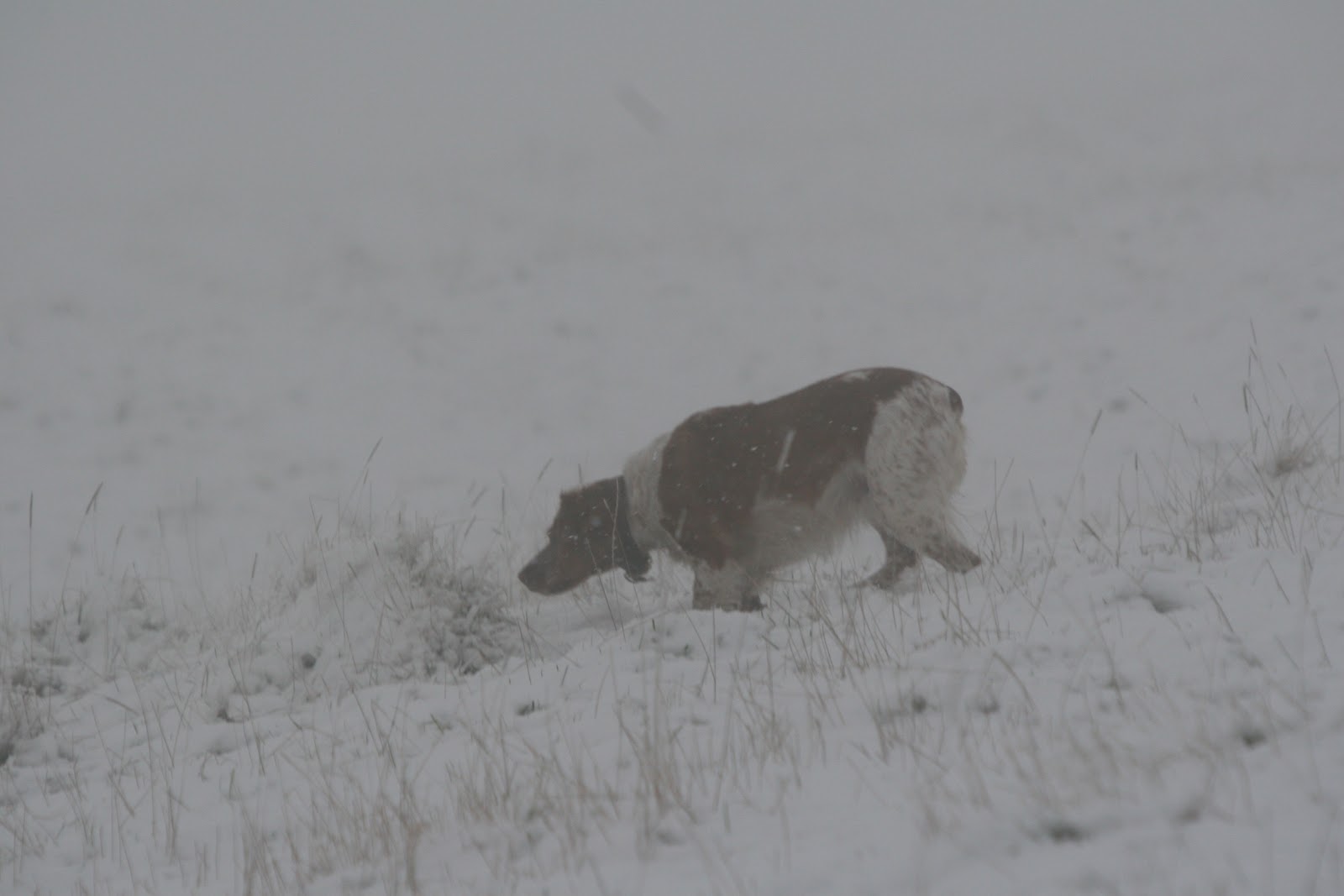
Above are some photos of Puzzle, my Brittany. She is a hunter, pointer,retriever, but I use her only for pointing. Macbeth has learned to pay attention to what the dog is doing and if the hawk goes off after something the dog will dash to keep up with her. They're a very good partnership, but it's taken seven years to get to this happy state of affairs. Cassius, my one year old male hawk is still a bit wary of the dog and she tends to put him off hunting. The top and bottom photos above show Puzzle pointing. It's a very distinctive bit of body language. It's as though the dog has hit an invisible wall and frozen solid. The smell of the pheasant, or rabbit, stops her dead in her tracks. It's got so that now I can tell how far ahead of her the pheasant/rabbit is, by noting how low to the ground her head is. The lower her head, the closer it is. The middle photo, I've included purely because it reminds me that dogs are descended from wolves.
At North Devon Hawk Walks, I'm lucky to have access to great hunting grounds, for pheasants, and so far this season I've taken out two customers, who both had a great time. Several more customers are booked in for our three hour hunts and I hope to get some photos of birds and dogs in action.
Take a look at www.NorthDevonHawkWalks.co.uk to get an idea of what we do.
Tuesday, 14 June 2011
Tuesday, 24 May 2011
Welcome !
Welcome to my blog. I run North Devon Hawk Walks and spend most of my time messing around with hawks on Exmoor, in Devon. I hope to use this blog to help introduce people to falconry and to share my experience of these fascinating creatures.
I've seen blogs described as " vanity web-sites" and I don't intend to let that happen to me! I'll be telling you what the hawks are up to, how they are behaving during our outings, either on hawk-walks or hunting for rabbits and pheasants, and passing on any tips or useful information I pick up that may be of use to other people owning, training or caring for hawks.
I have just two hawks, Lady Macbeth ( an 8 year old female), and Cassius ( a 9 month old male). Both are Harris Hawks. I'll be posting pictures of them in the near future. I hope to buy a female Sparrowhawk later this year. More about that later.
More about myself and the hawks at my website http://www.northdevonhawkwalks.co.uk/
I've seen blogs described as " vanity web-sites" and I don't intend to let that happen to me! I'll be telling you what the hawks are up to, how they are behaving during our outings, either on hawk-walks or hunting for rabbits and pheasants, and passing on any tips or useful information I pick up that may be of use to other people owning, training or caring for hawks.
I have just two hawks, Lady Macbeth ( an 8 year old female), and Cassius ( a 9 month old male). Both are Harris Hawks. I'll be posting pictures of them in the near future. I hope to buy a female Sparrowhawk later this year. More about that later.
More about myself and the hawks at my website http://www.northdevonhawkwalks.co.uk/
Subscribe to:
Posts (Atom)